
Product Description
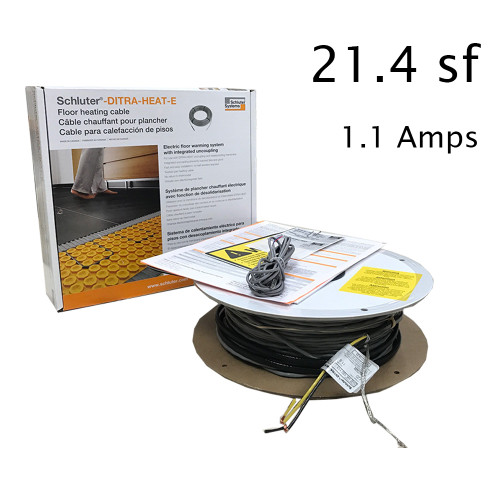
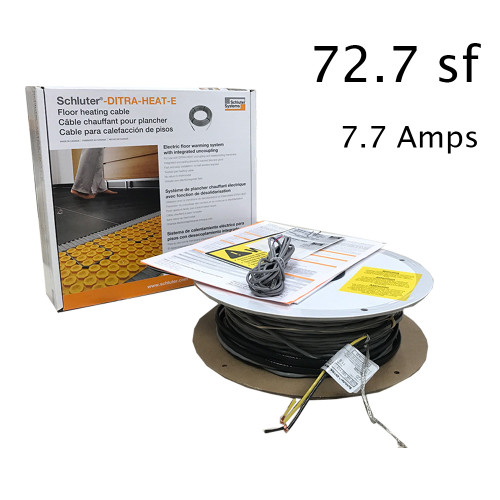
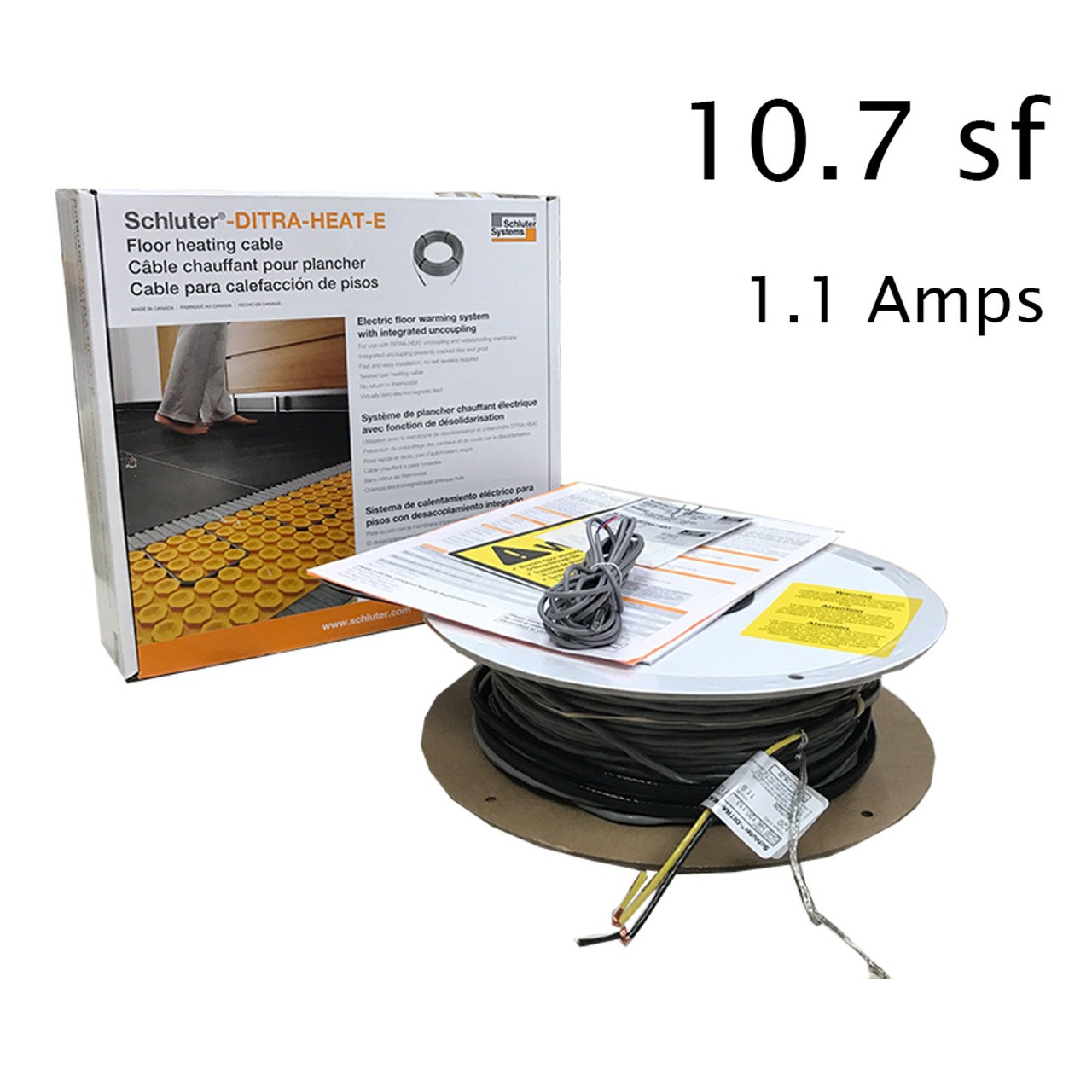
Schluter®-DITRA-HEAT-E-HK are twisted pair heating cables designed for integration with the DITRA-HEAT uncoupling membrane in interior floor warming applications.
- Cables snap into the membrane; clips and fasteners are not required
- No self-levelers required to encapsulate the cables; installation time significantly reduced
- No return to thermostat required
- Produces virtually zero electromagnetic fields
- 120 V and 240 V options available in a variety of lengths
IMPORTANT Ordering Information for Schluter®-DITRA-HEAT Cables
- Do not purchase a heating cable that is the same size as the area to be tiled; you will be left with too much heating cable!
- Very important: Never CUT or modify the heating cable in any way. This would change the cable resistance, will cause damage to the cable, and could cause cable overheating.
- Always keep a 3 stud (3-1/2" - 9 cm) spacing between heating cable runs. A narrower spacing may cause a fire or damage the floor covering. A wider spacing (e.g., 4 studs) may not provide sufficient power to warm the floor to the desired temperature. Exception: a two stud spacing is used when connecting the 240 V cable to a 208 V power supply. See the DITRA-HEAT Installation Handbook for more information.
- Minimum spacing from walls, partitions, and fixed cabinets is 2" (50 mm).
- Minimum spacing from other heat sources (baseboard heaters, fireplaces, forced air heating ducts, etc.) is 8" (200 mm).
- Minimum spacing from any plumbing drain is 4" (100 mm).
- Minimum spacing from centerline of toilet drains is 7" (180 mm).
- NEVER install the heating cable under vanities, bathtub platforms, free standing bathtubs, kitchen cabinets and islands or any other fixtures or in closets. Excessive heat will build up in these confined spaces and may cause cable overheating.
- NEVER install the factory splice (i.e., black plastic junction between the cold lead and gray heating cable) in the wall. This will cause overheating, system failure, and could cause a fire. This splice must be installed entirely under the floor covering, as shown in the heating cable installation instructions.
- It is helpful to plan the location of a buffer zone, as it is not always possible to predict where the heating cable will end. The buffer zone is an area where heating is not essential, typically behind a toilet or adjacent to a door opening. This area allows for placement of excess heating cable. Heating cables may also be installed 6" (150 mm) from the wall to create a buffer zone.
- Heating cable testing is required while the heating cable is on the spool and at two subsequent steps during installation to ensure cable quality and for warranty purposes. A megohmmeter is required for the insulation resistance testing of the heating cables. Insulation resistance testing is strongly recommended.
- Consult a qualified electrician before ordering DITRA-HEAT heating cables to ensure you order the correct voltage for your installation.